Saturday, October 27, 2018

Where our Forefathers have trod - Part 1

Last night, after taking three hours to get from Gettysburg, PA to Alexandria, VA (which is just on the other side of the Potomac River from Washington D.C.), we settled into our Air B&B which is located a few blocks from the wharf. This morning we took a river taxi down to Mount Vernon. For those of you not up on your American History, this was the home of George Washington and his family. The estate at one point in time was a total of 8000 acres all housing livestock, crops and gardens, and lots of wooded areas. Though, it was said that most of the money that was made was from fishing the river. I found a couple of interesting stories that I found interesting:

  • The British once threatened to burn down the estate if they weren't given rations. The estate manager who was George Washingtons cousin gave in and gave them what they asked for to save the estate. George Washington wrote him a letter and said that he would have been less disappointed had the manager refused and the estate was burned to the ground.
  • A two masted ship sailed up the Potomac to Mount Vernon in the 1800's, if I remember correctly, to commemorate the achievements that George Washington had accomplished during his life. While it was docked a hurricane came through this area and ripped the ship from its moorings. It was never seen again, nor has it ever been found.
We headed out on the boat and the guide showed us sights along the way. Unfortunately, the weather was less than stellar this morning, but some of us braved the Nor'easter and went up to the top deck to take pictures.

The Potomac
 They say the Potomac River used to be crystal clear because there used to be clams that were so numerous that they filtered out all the silt and sand in the water. It was said that it was so clear you could have seen to the e bottom and the clams looked like a cobblestone road on the bottom of the river. Unfortunately, in the late 1800's the clams were hunted out of the river to the point that they were no longer able to filter the water. Though it looks polluted, it is not. It is just all the stirred up silt and sand. If they tried to put clams back in the river they would die, because there is just too much to filter now.
The President showed up.
As I mentioned, there were points of interest along the way. One was a replica of Air Force One, nowhere near an air strip. It is a tourist attraction at one of the more expensive ports on the river. No, the President was not there. Other points included Fort Washington, and the only river lighthouse still standing today. Towards the end of our boat ride it became foggy enough that we could not see shore very well.

Once we arrived at the dock at Mount Vernon, we disembarked and started our self tour.

An example of how George Washington set up his plantings.

Washington would often experiment with different fertilizers to see which was best and the fastest growth.

A replica of a grain barn which he built to ease the processing  grain

He put gaps in the floor to allow wheat to separate from the stalks.

George Washington, and many others at the time were smarter than we give them credit for. Many of the farming tactics that Washington used in the 1700's are still in use today, and they still work today. Now who still believes that they didn't know what they were doing when they wrote the Constitution and Declaration of Independence?

This is a replica example of what Washingtons field slaves would have lived in. Just a simple log cabin.

George and Martha Washingtons grave site.

As far back as the early 1800's people would carve their names into the brick here. Not to desecrate the grave but as a way to pay their respects.

Mansion as seen from the Bowling Green. They didn't have mowers, so they  used rollers to keep the grass "neat"

Inside the mansion this is where any visitors "help" would stay.

The "new room," used for entertaining and dining with visitors. 

I thought the fireplace work was cool, as well as the ceiling in the above picture.

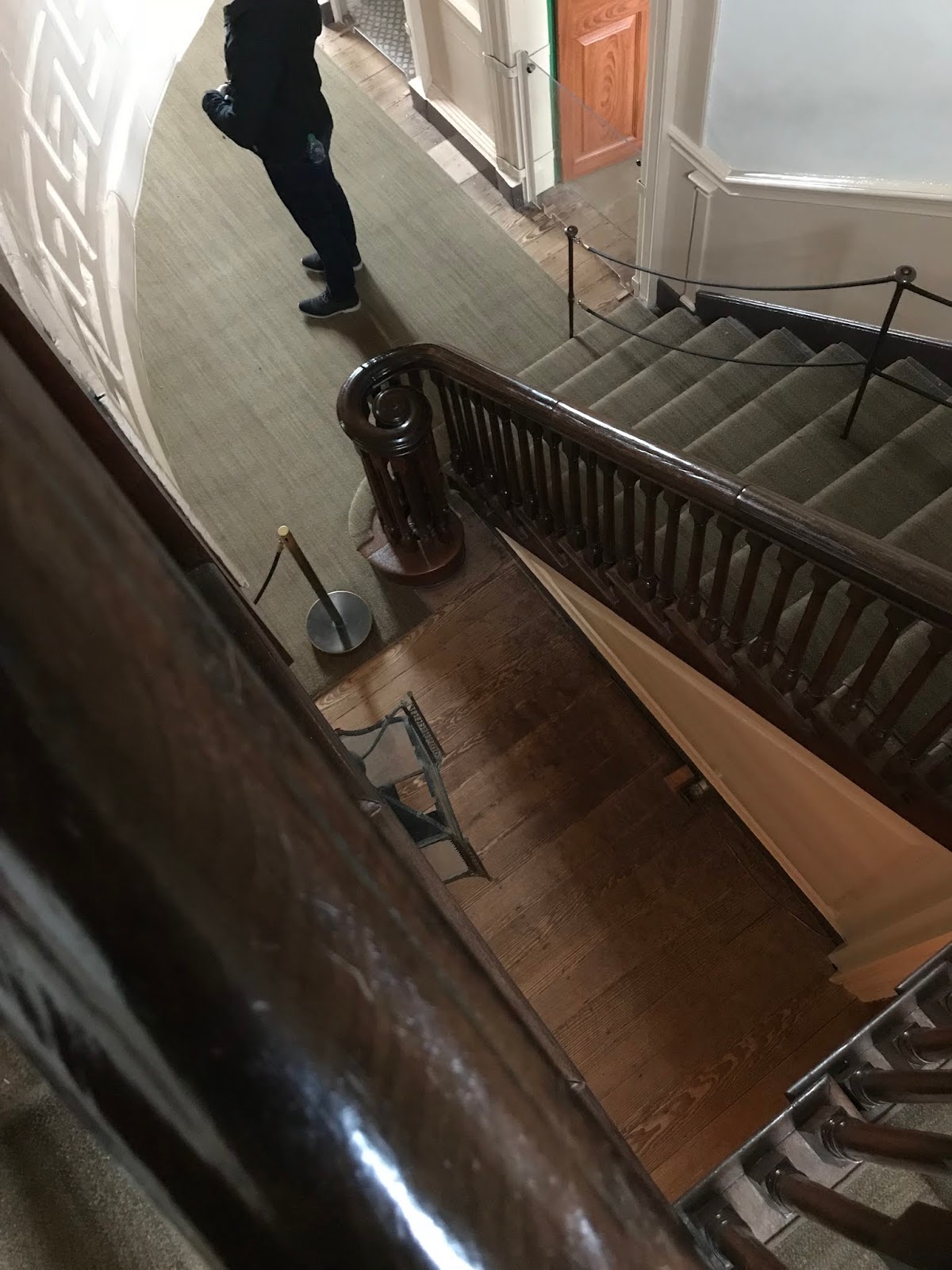
Main stair case in the main house where the guest rooms were - all original.

The view from the breezeway. 

The kitchen, separate from the house.
There were plenty of other rooms in the house. You probably wouldn't want to see them all. I guess you will have to come out here and see the place for your self! A couple of interesting facts.

  • Guests would be put in a room depending on how familiar the Washingtons were with you. If they didn't know someone well or came unannounced, they would be put into the least nicest quarters. If you were someone close to the family or another important figure doing business with the Washingtons there was a nice room just for you! 
  • As far as the Few family was concerned during this time, William Few as well as his wife were noted as being a guest to dine with the Washingtons as noted in George Washingtons personal journal. I would like to think at some point that William Few walked these same floors.
Front view from the carriage round about.

George Washington would often ride these chair carts as they were more maneuverable than the four wheeled carriages.

Washingtons stables.

There were no supermarkets. For produce estates had a kitchen garden.

Want to see where George Washington went #2?

Here you go, apparently it was communal. ;)

The bunk house where the house slaves would have been housed.

Mount Vernon Pier
Today was a good day, we got to see a glimpse into life in the 1700's. As I mentioned earlier, the dude  had a brain. The weather is looking up for the next couple of days as we move on to viewing the museums and monuments. 

Friday, October 26, 2018

When we weren't so Civil.

Today was one of our more solemn stops on our trip. Gettysburg - one of the more pivotal battles of the Civil War. We were able to visit the recently updated museum and take the self guided driving tour around the battlefield. There was a lot to take in, and we definitely could have taken more time to   look around. Following the pictures I took today I will be writing about how the Few family was involved. in the war.

Part of the Cyclorama painting depicting the battle.

Part of a tree that bears the remnants of the fighting those two days.

Cannon balls retrieved from the battlefield.

Generals sleeping quarters.

Ranking officers sleeping arrangement foreground, enlisted slept in tents like the one shown in the background.

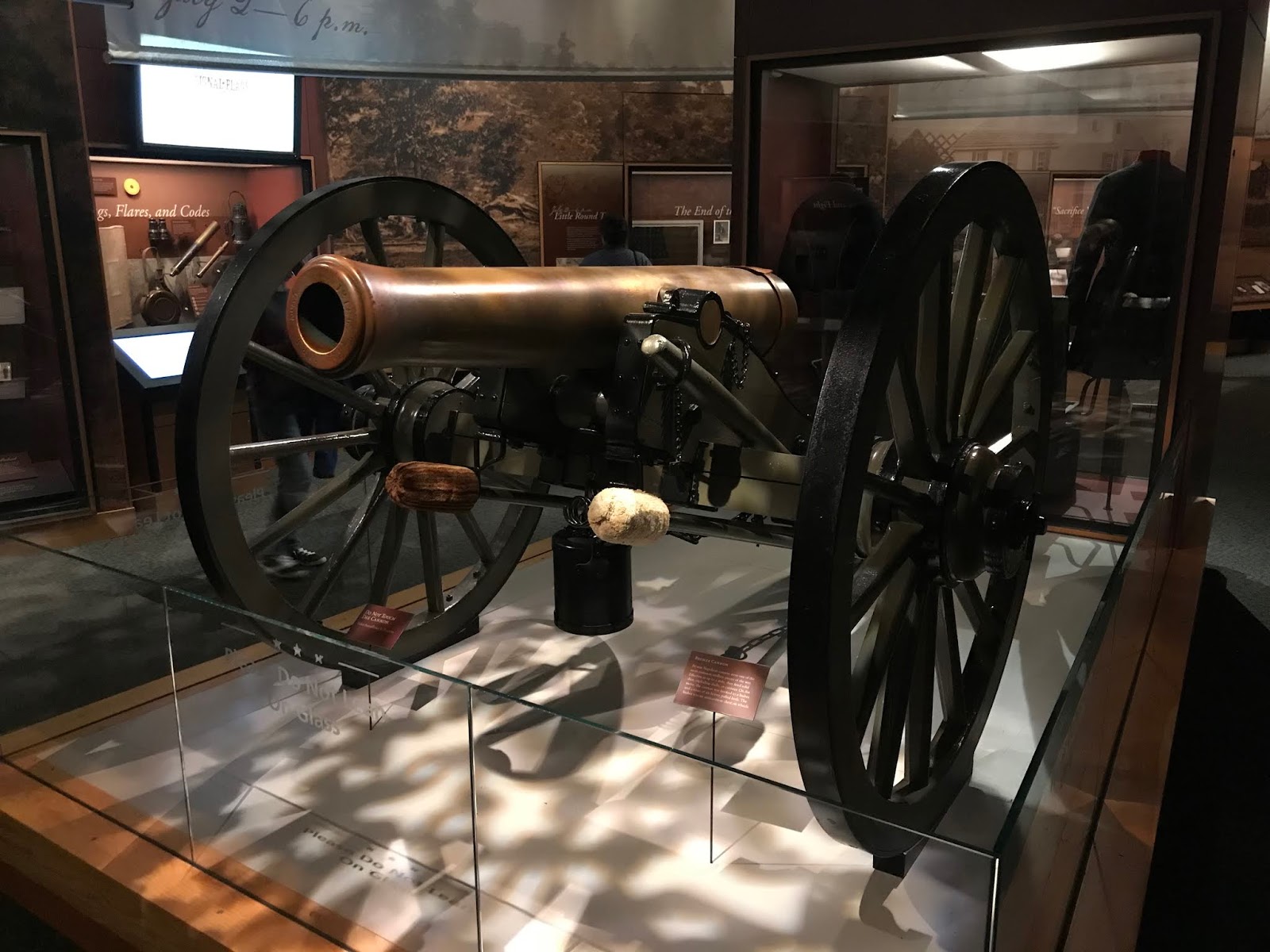
Cannon used at Gettysburg.

Map of the driving tour.

Part of the battlefield.

800m cannons were used in the battle, 600 of them line many of the roads around the area.

Many monuments to different regiments and prominent figures dot the landscape. From the Norm and the South.


In the distance you can see the town of Gettysburg where we stayed last night.


As far as the Few family is concerned, I know that there were Few's that fought on both sides of the Civil War. The idea that brother fought brother rings true in my family. In fact, it brought them to financial ruin. Before the war, the Few family owned large estates and ran plantations. As noted, some owned slaves and others did not. Which ever the case, whatever side they fought on they put all of their assets towards the cause. After the Civil War, the Few dependents became simple farmers for a time, and eventually went to other blue collar careers. Many moved further west to find peace and a new life.

For the next few days we will be exploring Washington D.C. and surrounding areas. Come back again tomorrow!

Thursday, October 25, 2018

Hanging out with the Founding Fathers.

Today we spent the day in Philadelphia. For a couple of reasons, one being that the Philadelphia area is where the first recorded mentions of the Few name were noted in the New World. Secondly, being the hub for the quest for Independence, it is where William Few came to sign The Constitution.

Richard Few (spelled "Fue" at the time) and his family was one of the "First Purchasers" of land acquired by William Penn. In fact the Few family arrived just prior to William Penn's official recorded arrival according to records kept at the time. They were Quakers fleeing religious persecution from the King of England. They were able to acquire 500 acres located outside of Philadelphia to the west as well as a five acre bonus city lot within city limits. From what I can tell from maps of the period, what the area looks like now is all industrial. It is interesting to think about how things used to look like 200+ years ago.

The general area where the 5 acre city lot owned by Richard Few may have been located.  Near the banks of the Schuylkill River in Philadelphia, PA.
Richard Few and his family eventually divided out the land he had acquired, and moved further west to a new township called Chester in Chester County, PA. These are still present today. Richard would eventually go on to become a Constable as well as the repairer of roads and highways for the area.

Sign for Chester, PA
The back side of Chester, PA
Issac Few, Richards son moved on further west to the township of Kennet, PA. He also went on to be a part of the local government as well as to help set up the Quaker meeting house there. Although I imagine it is not the same building, it is in the same general spot as it was back in the early 1700's.

The town of present day Kennett, PA
Quaker Meeting house in Kennett.
The Few family later went on to moved to North Carolina and Georgia. We will talk more about those in later posts. All you need to know today is that in 1787, William Few Jr. made his was back to Philadelphia over 100 years after the first Few's arrived, and signed the Constitution for the state of Georgia in Independence Hall. We toured the building and saw where the delegates for Georgia would have sat during deliberations. Someone can feel free to correct me, but I may just be one of the  few Few's to step in the room since it was signed. At the least, in my branch of the family tree. ;)

Independence Hall. It was likely the most prominent building at one time. Not anymore!

Courtroom of Independence Hall

The "Signing Room" William Few and his co-signer for Georgia, Abraham Baldwin sat at the table in the corner by the window.

The rest of the room, including the very chair that George Washington sat in leading the deliberations.

Plaque on the side of Independence Hall.

Clocktower on Independence Hall.
Our next stop was the Liberty Bell. Its been cool to think that the Liberty Bell would have been heard by William Few when meetings were called into session.

Whenever the bell was repaired people would either steal or sell pieces of the Liberty Bell  and make lots of money from the relic. They would either keep the pieces or make them into or a part of various items.

Liberty Bell and its attempted repairs.
After the Liberty Bell we made our way to the Constitution Center. This was an interesting experience. Their presentations on the current state of the debates on various amendments were both informative and grounded in fact. If you ever have the opportunity to visit I would recommend it. You may learn something new no matter where you stand on many issues.

The flag from in the Constitution Hall.
The main reason we went, though, was to visit the Signers Room. Here they have true to life depictions of each and ever signer and of George Washington based on the information they had from that period. You'll be happy to know that Although George Washington may have been the tallest in the room, I still beat him by four inches! We were able to find William Few and what he probably would have looked like. See any resemblance? ;)

The Signers Room.

Statue of William Few.

39 Years old when he signed. Only six years ahead of me!

I was able to sign my name to an electronic version of the Constitution. Pretty cool!

After losing then finding Crista's wedding ring in a downtown Philadelphia parking garage, we made our way down to Gettysburg for tonight. Come back tomorrow for more on that!